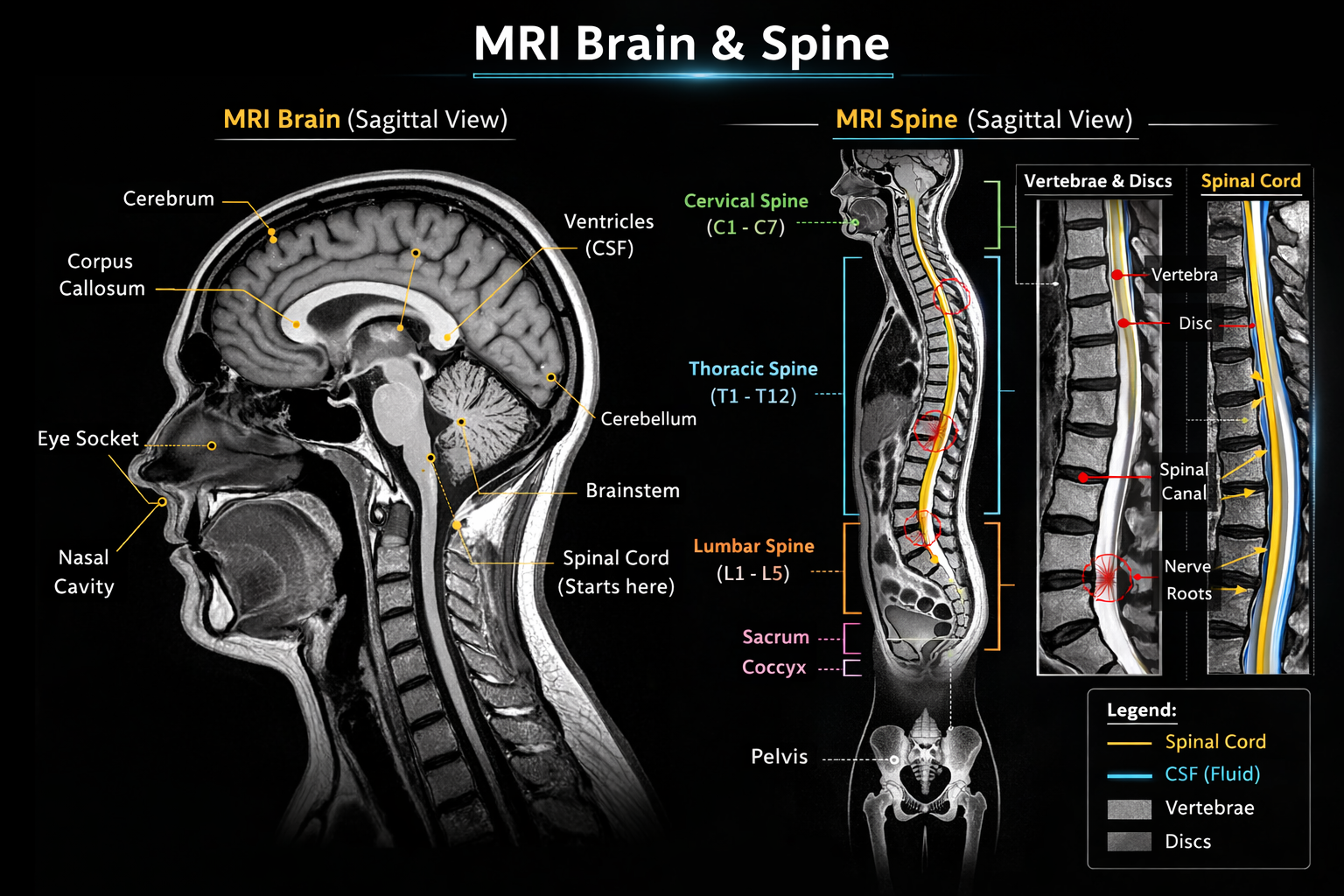
Magnetic Resonance Imaging (MRI) of the brain and spine is a highly advanced, non-invasive imaging technique used to evaluate neurological structures with exceptional clarity and detail. Unlike X-rays or CT scans, MRI uses powerful magnetic fields and radio waves to create detailed images of the brain, spinal cord, nerves, and surrounding tissues. MRI Brain & Spine scans are essential tools in modern neurology, helping detect a wide range of conditions including stroke, tumors, multiple sclerosis, infections, spinal disc disorders, and degenerative diseases. The procedure is painless and does not involve radiation, making it a safe and reliable diagnostic method for patients of all ages when clinically indicated.
An MRI Brain & Spine scan is recommended when patients present with symptoms suggestive of neurological dysfunction or structural abnormalities. Causes for ordering this imaging may include persistent headaches, seizures, sudden weakness, numbness, unexplained dizziness, visual disturbances, back pain, neck pain, or difficulty walking. It is also commonly used to investigate suspected brain tumors, spinal cord compression, slipped discs, congenital abnormalities, inflammatory diseases, trauma-related injuries, or complications following infections. In many cases, MRI plays a crucial role in identifying the underlying cause of symptoms that cannot be explained by routine clinical examination alone.
Symptoms that may prompt the need for an MRI Brain & Spine evaluation vary depending on the suspected condition. Patients may experience chronic or severe headaches, memory problems, behavioral changes, seizures, limb weakness, tingling sensations, balance difficulties, or coordination issues. Spinal conditions may present with radiating pain down the arms or legs, numbness, muscle weakness, stiffness, or bladder and bowel disturbances. Early imaging helps ensure timely diagnosis and prevents potential progression of neurological damage.
MRI is one of the most accurate imaging methods for diagnosing neurological and spinal disorders. During the procedure, the patient lies comfortably inside a specialized scanner that captures detailed cross-sectional images. In certain cases, contrast dye may be administered to enhance visualization of blood vessels, tumors, or inflammatory changes. The images are carefully analyzed to detect abnormalities such as brain lesions, hemorrhage, tumors, nerve compression, disc herniation, spinal canal narrowing, or demyelinating diseases like multiple sclerosis. MRI findings, combined with clinical examination and other investigations, allow precise diagnosis and guide appropriate treatment planning.
While MRI itself is a diagnostic tool and not a treatment, the results play a vital role in determining the most effective management strategy. Depending on the findings, treatment may include medications, physiotherapy, lifestyle modifications, minimally invasive procedures, or surgical intervention. For example, brain tumors may require neurosurgical evaluation, spinal disc prolapse may be managed conservatively or surgically, and inflammatory conditions may respond to targeted medical therapy. Accurate imaging ensures that treatment is personalized and evidence-based, improving outcomes and reducing unnecessary interventions.
Post-treatment care depends on the diagnosed condition and the therapy provided. Patients undergoing medical management may require regular follow-up visits and repeat imaging to monitor progress. Those who have had surgical procedures may need rehabilitation, physiotherapy, and ongoing neurological assessment. MRI follow-up scans are often used to evaluate healing, confirm resolution of lesions, or assess response to treatment. Continuous monitoring ensures long-term neurological stability and helps prevent recurrence or complications.
MRI Brain & Spine is considered extremely safe because it does not use ionizing radiation. However, patients with certain metal implants, pacemakers, or metallic foreign bodies must inform their doctor prior to scanning, as strong magnetic fields may interfere with these devices. Some individuals may experience mild discomfort due to claustrophobia during the scan, though open MRI options or mild sedation can help in such cases. When contrast dye is used, allergic reactions are rare but possible. Overall, MRI remains a low-risk and highly effective diagnostic investigation.
You should consult a neurologist if you experience persistent headaches, unexplained seizures, sudden weakness, progressive back or neck pain, numbness, memory problems, or changes in coordination. Early evaluation and timely MRI Brain & Spine imaging can help identify serious conditions before they worsen. Prompt diagnosis not only improves treatment outcomes but also provides reassurance and clarity for patients and their families.
MRI Brain & Spine plays a critical role in modern neurological care by offering precise, non-invasive visualization of complex neural structures. When guided by expert clinical judgment, it becomes an invaluable step toward accurate diagnosis, effective treatment, and long-term neurological health.
Chat With Me